

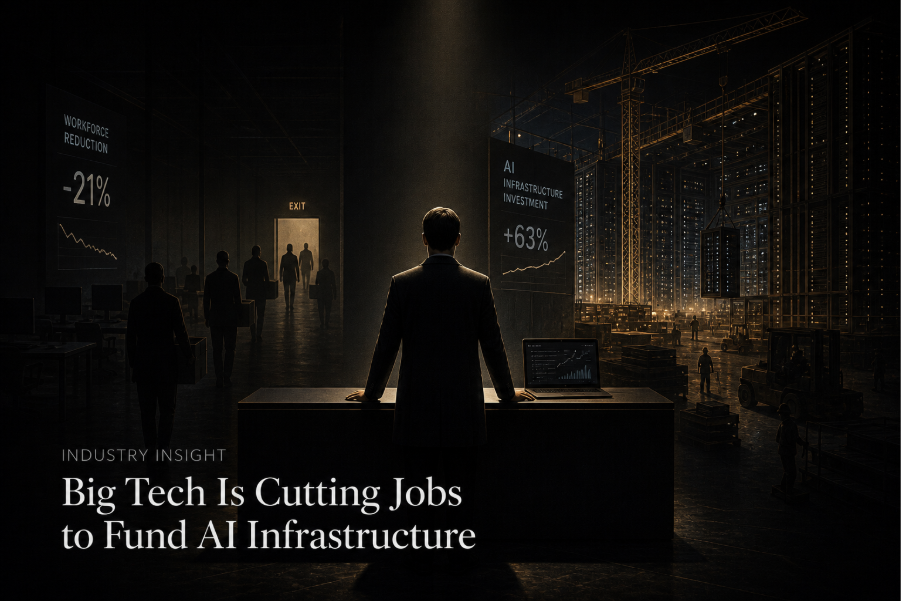
From Meta to Oracle, the industry’s biggest players are making an explicit trade: human headcount for compute. The result is the worst wave of tech layoffs in years — and the bosses are barely hiding why.
KEY FIGURES
- 92,000+ tech workers laid off in 2026 so far, across 95+ companies
- $650 billion combined 2026 capital expenditure planned by Amazon, Google, Meta & Microsoft
- 45,800 tech jobs cut in March alone — the worst single month in over two years
- +580% increase in tech layoffs in Q1 2026 vs. Q4 2025
A position at a big tech company came with an unstated guarantee for decades: the industry expands, and you go along for the ride. Or this: That promise is being torn apart systemically, and transparently, and for the first time in years, suited men are telling their white-collared minions where that cash is headed instead.
So far in 2026, basic business analysts have found that something like 92,000 individual technology workers have been laid off at more than 95 companies. Layoffs in the sector are up by 580% versus Q4 of 2025. In total, 45,800 cuts were recorded last March — the worst month in more than two years in one portion of the economy alone. This wave is preceded by previous rounds, which framed the news as consequences of mini-leverage pandemic-era overhiring or unforeseen macroeconomic headwinds; this round has a new, and less sophisticated explanation: we need the cash for AI.
The Two Cost Centers
No executive has been more blunt about this than Meta CEO Mark Zuckerberg. In a company town hall, as Meta revealed plans to eliminate approximately 8,000 employees–roughly 10% of the company’s workforce–Zuckerberg described its financials in comparatively stark language: there are two big cost centers—the compute infrastructure and people. Experience suggests that with the same amount of capital flowing towards AI hardware, there is less capital for headcount.
“We basically have two major cost centers in the company: compute infrastructure and people-oriented things.”
— Mark Zuckerberg, Meta CEO, company town hall
The announcement came the same week Meta raised its full-year 2026 capital expenditure forecast to between $125 billion and $145 billion: nearly double its $72.2 billion in capex for all of 2025. Zuckerberg also declined to rule out further reductions later in the year.
A Pattern Across the Industry
Meta is far from alone. Amazon, which is planning to spend approximately $200 billion on capital expenditures in 2026, has cut at least 30,000 corporate jobs since October 2025, roughly 10% of its corporate and tech workforce. The company’s stated rationale was “streamlining operations,” but analysts noted the timing corresponded directly with AI systems coming online across its retail, logistics, and cloud businesses.
Oracle has gone even further, announcing cuts of up to 30,000 employees, about 18% of its 162,000-person workforce, and the largest layoff in the company’s history. The cuts are funding an estimated $8 to $10 billion annual buildout of AI data centers and Oracle Cloud Infrastructure, a direct reallocation from human workers into silicon, networking, and physical real estate.
Microsoft, meanwhile, has taken a softer approach but pointed in the same direction: the company is offering voluntary buyouts to approximately 8,750 U.S. employees, roughly 7% of its American workforce, and the first such program in its 51-year history. The buyout targets workers whose combined age and years of tenure total at least 70, effectively offering an early exit to long-serving staff as the company redirects spending toward AI infrastructure and specialized talent.
Snap cut 16% of its workforce, citing AI-driven efficiencies. Salesforce eliminated 4,000 customer support roles, with CEO Marc Benioff stating simply: “I need less heads.” In earnings calls, Meta and Amazon executives referenced the word “efficiency” 15 times between them.
The Overhiring Caveat
Behind these strategic narratives lies a secondary reality: many large tech firms entered 2024 and 2025 meaningfully overstaffed after pandemic-era hiring binges. The cuts, in some cases, are correcting genuine excess, not purely funding AI ambitions. Analysts at Wedbush have framed the broader wave as a strategic pivot rather than a sign of financial distress.
But the pivot narrative does not fully explain the scale or timing. These are profitable companies raising their capital expenditure forecasts while simultaneously cutting headcount. The Washington Post noted that across recent earnings calls, Microsoft’s chief financial officer said headcount would decline this year as the company emphasizes “pace and agility”, language that, in context, means fewer people doing more with AI tools.
Fewer People, More Revenue
The startup world is already demonstrating what this future looks like at scale. Venture capitalists report companies reaching $50 million in annual revenue with as few as 50 employees, a headcount that, for a comparable software business five years ago, would have supported only a fraction of that revenue. Companies operating with that ethos are finding it significantly easier to raise capital. Those that aren’t are being squeezed.
Wall Street has responded predictably. When Meta announced its layoffs, the stock fell initially, then recovered and exceeded prior levels within days. Microsoft shares followed a near-identical pattern. The market is effectively pricing in a model where workers are replaced by compute, and capital expenditure on AI infrastructure is treated as investment rather than cost.
The Bigger Question
More than 92,000 tech workers have lost their jobs in 2026. The companies laying them off are, collectively, among the most profitable in human history. Amazon alone plans to spend $200 billion on capital expenditures this year. The cuts are not happening because these businesses are struggling. They are happening because the executives running them have decided that the next dollar is better spent on a GPU than on a person.
Whether that decision ultimately creates broadly shared prosperity, through lower prices, new products, or downstream employment or simply concentrates gains at the top is a question the industry has not answered. For now, the trade is happening in plain sight, and the CEOs are no longer pretending otherwise.
